Buy bestseo.eu ?
We are moving the project
bestseo.eu .
Are you interested in purchasing the domain
bestseo.eu ?
domain@kv-gmbh.de · 0541-91531010
Buy bestseo.eu ?
What are prisms?
Prisms are three-dimensional geometric shapes with two parallel and congruent polygonal bases connected by rectangular or parallelogram faces. They are classified based on the shape of their bases, such as triangular prisms, rectangular prisms, or pentagonal prisms. Prisms have a constant cross-section along their length, and light passing through them is refracted or dispersed, making them useful in optics and physics experiments. They are commonly used in architecture, photography, and mathematics for their unique properties and applications. **
Why are cubes and rectangular prisms special types of prisms?
Cubes and rectangular prisms are special types of prisms because all of their faces are rectangles. This means that they have congruent opposite faces and parallel edges, which makes them easier to work with in terms of calculating surface area and volume. Additionally, cubes are a special type of rectangular prism where all of the edges are the same length, making them even more unique. These properties make cubes and rectangular prisms important and useful shapes in mathematics and everyday life. **


Similar search terms for Prisms
Top-Angebote
Products related to Prisms:
-
Assemble! Card Game by Alderac Entertainment Group - Team Building Strategy GameBuild a team of heroes in Assemble!, a fast-paced card game about creating the ultimate team from a colourful cast of heroic archetypes. Players take on the role of strategists, combining characters with different strengths, styles, and abilities to shape their line-up. Every hero offers a distinct role, from fearless leaders and brilliant tacticians to powerful heavy hitters and unpredictable wildcards. The challenge is to recognise how these contrasting personalities work together and assemble a team with the right balance of talent. Enjoy a lively team-building card game where you combine heroes with varied roles and abilities. Make tactical choices as your team develops and discover new combinations from one game to the next. With its accessible theme and engaging decisions, Assemble! is suited to players who enjoy imaginative card games, strategic choices, and friendly competition. Gather your team, find the best combination of heroes, and see whether your strategy can bring them together.12,99 £*Shipping: 3,95 £Secure redirect to the provider
-
Stonemaier Games Tapestry Board Game - Strategy Game for Civilization Building and ExplorationBuild a civilization across the ages in Tapestry, a strategy board game. Players create and develop a unique civilization, guiding it from the earliest days of humankind into the future. Each civilization follows its own path, shaped by the choices made throughout the game. Explore new territories, advance your technology, develop your capital city, and expand your civilization's influence.83,26 £*Shipping: 0,00 £Secure redirect to the provider
-
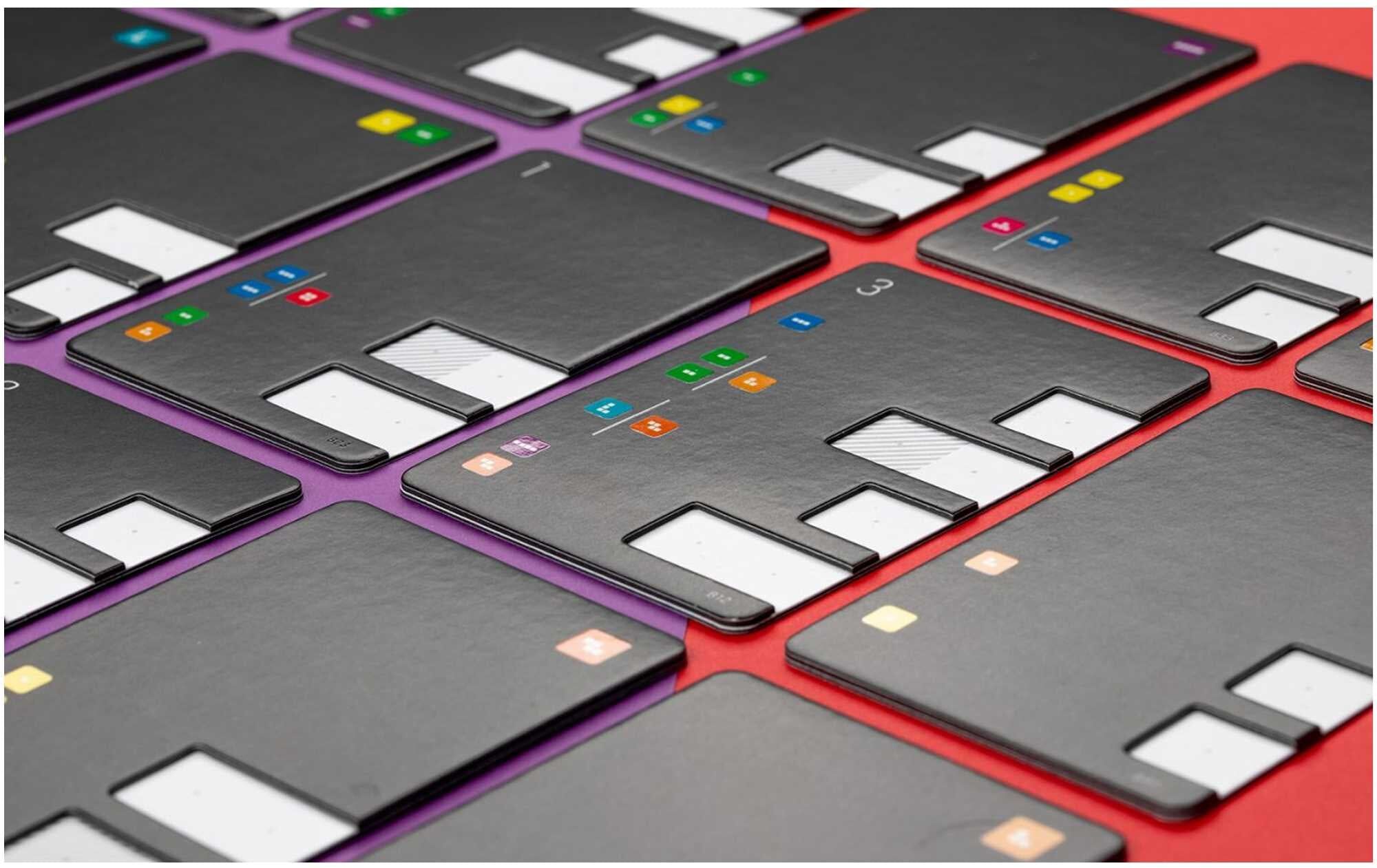
Square One - Engine-Building Strategy Game for 1-4 Players - PandaGM - NewFast-paced engine-building strategy game for 1-4 players. Includes tactile playing pieces and a focused game system built around completing sequences and triggering combinations.28,00 £*Shipping: 3,95 £Secure redirect to the provider



-
What are mathematical prisms?
Mathematical prisms are three-dimensional shapes that have two parallel and congruent polygonal bases connected by rectangular faces. The bases can be any polygon, such as a triangle, square, or pentagon. The height of the prism is the perpendicular distance between the two bases. The volume of a prism is calculated by multiplying the area of the base by the height. **
-
What are redirecting prisms?
Redirecting prisms are optical devices that are used to redirect the path of light rays. They are typically made of glass or plastic and have two flat surfaces that are angled in such a way that they can change the direction of light passing through them. Redirecting prisms are commonly used in various optical instruments such as binoculars, periscopes, and cameras to allow the user to see objects that are not in their direct line of sight. **
-
What are deflecting prisms?
Deflecting prisms are optical devices that are used to redirect a beam of light by a specific angle without changing its direction. They are typically made of glass or other transparent materials with precise angles that allow for controlled deflection of light. Deflecting prisms are commonly used in various optical instruments and devices, such as periscopes, rangefinders, and laser systems, to manipulate the path of light for specific applications. **
-
What are these prisms called?
These prisms are called triangular prisms. They have two triangular bases and three rectangular faces. Triangular prisms are a type of prism where the cross-section parallel to the bases is always a triangle. **


What are cuboids and prisms?
Cuboids and prisms are both three-dimensional geometric shapes. A cuboid is a specific type of prism that has six rectangular faces, with opposite faces being equal in size and shape. A prism, on the other hand, is a solid figure with two parallel and congruent polygonal bases, and rectangular or parallelogram faces connecting the corresponding sides of the bases. In summary, all cuboids are prisms, but not all prisms are cuboids. **
What formulas are there for prisms?
The formulas for prisms include the surface area formula, which is given by 2 times the base area plus the perimeter of the base times the height of the prism. The volume formula for a prism is the base area times the height of the prism. Additionally, the lateral surface area of a prism can be calculated by finding the perimeter of the base and multiplying it by the height of the prism. **
Top-Angebote
Products related to Prisms:
-
Aporta Games Norsewind Tableau-Building Strategy Game - Card Games - MultiIn Norsewind, the year is 793 and the kingdoms of Anglo-Saxon England face an advancing Viking threat. Take control of Wessex, Mercia, Northumbria, or East Anglia and develop your realm while preparing for attack. This tableau-building strategy game challenges you to select cards and add them to your growing kingdom. Place each card carefully to create useful combinations, gather helpful followers, and improve your castles. Expansion brings rewards, but a larger kingdom can also attract stronger Viking attacks. At the end of the game, assess each row in your tableau and score it only when your defenses can withstand the Viking power. The game features a unique blend of strategy and luck, requiring you to balance growth, preparation, and tactical placement to emerge victorious.24,97 £*Shipping: 3,95 £Secure redirect to the provider
-
Groo: The Game by Steve Jackson Games - Town Building Strategy GameBuild a town while trying to keep Groo the Barbarian from reducing it to rubble. This game brings Sergio Aragonés’ comic character to the table, where rival armies and Groo’s visits threaten your plans. Players roll dice to generate resources, spend those resources on buildings or troops, and pass any unused resources to their rivals. The combination of town building and unpredictable visits creates competition around the table. One complete Groo game is supplied.29,19 £*Shipping: 3,95 £Secure redirect to the provider
-
Assemble! Card Game by Alderac Entertainment Group - Team Building Strategy GameBuild a team of heroes in Assemble!, a fast-paced card game about creating the ultimate team from a colourful cast of heroic archetypes. Players take on the role of strategists, combining characters with different strengths, styles, and abilities to shape their line-up. Every hero offers a distinct role, from fearless leaders and brilliant tacticians to powerful heavy hitters and unpredictable wildcards. The challenge is to recognise how these contrasting personalities work together and assemble a team with the right balance of talent. Enjoy a lively team-building card game where you combine heroes with varied roles and abilities. Make tactical choices as your team develops and discover new combinations from one game to the next. With its accessible theme and engaging decisions, Assemble! is suited to players who enjoy imaginative card games, strategic choices, and friendly competition. Gather your team, find the best combination of heroes, and see whether your strategy can bring them together.12,99 £*Shipping: 3,95 £Secure redirect to the provider
-
Stonemaier Games Tapestry Board Game - Strategy Game for Civilization Building and ExplorationBuild a civilization across the ages in Tapestry, a strategy board game. Players create and develop a unique civilization, guiding it from the earliest days of humankind into the future. Each civilization follows its own path, shaped by the choices made throughout the game. Explore new territories, advance your technology, develop your capital city, and expand your civilization's influence.83,26 £*Shipping: 0,00 £Secure redirect to the provider
-
What are prisms?
Prisms are three-dimensional geometric shapes with two parallel and congruent polygonal bases connected by rectangular or parallelogram faces. They are classified based on the shape of their bases, such as triangular prisms, rectangular prisms, or pentagonal prisms. Prisms have a constant cross-section along their length, and light passing through them is refracted or dispersed, making them useful in optics and physics experiments. They are commonly used in architecture, photography, and mathematics for their unique properties and applications. **
-
Why are cubes and rectangular prisms special types of prisms?
Cubes and rectangular prisms are special types of prisms because all of their faces are rectangles. This means that they have congruent opposite faces and parallel edges, which makes them easier to work with in terms of calculating surface area and volume. Additionally, cubes are a special type of rectangular prism where all of the edges are the same length, making them even more unique. These properties make cubes and rectangular prisms important and useful shapes in mathematics and everyday life. **
-
What are mathematical prisms?
Mathematical prisms are three-dimensional shapes that have two parallel and congruent polygonal bases connected by rectangular faces. The bases can be any polygon, such as a triangle, square, or pentagon. The height of the prism is the perpendicular distance between the two bases. The volume of a prism is calculated by multiplying the area of the base by the height. **
-
What are redirecting prisms?
Redirecting prisms are optical devices that are used to redirect the path of light rays. They are typically made of glass or plastic and have two flat surfaces that are angled in such a way that they can change the direction of light passing through them. Redirecting prisms are commonly used in various optical instruments such as binoculars, periscopes, and cameras to allow the user to see objects that are not in their direct line of sight. **
Similar search terms for Prisms
-
Square One - Engine-Building Strategy Game for 1-4 Players - PandaGM - NewFast-paced engine-building strategy game for 1-4 players. Includes tactile playing pieces and a focused game system built around completing sequences and triggering combinations.28,00 £*Shipping: 3,95 £Secure redirect to the provider
-
Apiary Competitive Strategy Board Game - Worker-Placement Hive-Building for 1-4 PlayersBuild a thriving spacefaring hive in Apiary, a competitive worker-placement and hive-building board game from Stonemaier Games. Players develop their hives by assigning specialized bees to gather resources, explore the surrounding universe, and expand their growing colonies. Each decision helps shape your engine and determines how efficiently your hive can develop. Apiary combines worker placement with resource management, exploration, and tableau-building elements. The game offers multiple strategic routes, allowing players to focus on different aspects of hive development during each session.59,47 £*Shipping: 0,00 £Secure redirect to the provider
-
Czech Games Edition Lost Ruins of Arnak - Strategy Board Game - Deck-Building Worker PlacementExplore a mysterious island in Lost Ruins of Arnak, a strategy board game that combines deck-building with worker placement. Lead an expedition seeking lost knowledge, manage limited resources, and uncover the secrets of an ancient civilization. Each player develops their own expedition while competing to discover valuable artifacts, overcome guardians, and advance along research tracks. Cards, workers, and carefully timed actions must be combined to make the most of every turn. This game features strategy gameplay, exploration, research, and replayability, making it suitable for players who enjoy thoughtful strategy and adventure-themed tabletop games.54,00 £*Shipping: 0,00 £Secure redirect to the provider
-
What are deflecting prisms?
Deflecting prisms are optical devices that are used to redirect a beam of light by a specific angle without changing its direction. They are typically made of glass or other transparent materials with precise angles that allow for controlled deflection of light. Deflecting prisms are commonly used in various optical instruments and devices, such as periscopes, rangefinders, and laser systems, to manipulate the path of light for specific applications. **
-
What are these prisms called?
These prisms are called triangular prisms. They have two triangular bases and three rectangular faces. Triangular prisms are a type of prism where the cross-section parallel to the bases is always a triangle. **
-
What are cuboids and prisms?
Cuboids and prisms are both three-dimensional geometric shapes. A cuboid is a specific type of prism that has six rectangular faces, with opposite faces being equal in size and shape. A prism, on the other hand, is a solid figure with two parallel and congruent polygonal bases, and rectangular or parallelogram faces connecting the corresponding sides of the bases. In summary, all cuboids are prisms, but not all prisms are cuboids. **
-
What formulas are there for prisms?
The formulas for prisms include the surface area formula, which is given by 2 times the base area plus the perimeter of the base times the height of the prism. The volume formula for a prism is the base area times the height of the prism. Additionally, the lateral surface area of a prism can be calculated by finding the perimeter of the base and multiplying it by the height of the prism. **
* All prices are inclusive of VAT and, if applicable, plus shipping costs. The offer information is based on the details provided by the respective shop and is updated through automated processes. Real-time updates do not occur, so deviations can occur in individual cases. ** Note: Parts of this content were created by AI.